
When investing for retirement, two well-known vehicles include stocks and real estate. Although many have seen great fortunes in both asset types, there are distinct advantages within real estate that are not seen with any other investment, including stocks. Those who are drawn into real estate usually come with one of two general ideologies with respect to stock investing. In one case, they have become frustrated with the inevitable ups and downs that come with stocks and the lack of control with this investment - and want nothing to do with stocks or bonds. In the other case, they recognize the value of diversifying their current stock heavy investments into real estate - and choose not to “put all their eggs in one basket.” In the latter case, there is certainly good merit for this line of reasoning since a great deal of research has shown that even a 20% diversification into real estate will lead to increased returns with less volatility, when compared to a pure “stocks and bonds” portfolio. Regardless of the reasoning, investing in core real estate offers very unique advantages that just cannot be seen with any other investment.
To illustrate, let us consider an investment of $100,000 in common stock vs. real estate.
1. Nature of Asset:
Let’s face it. There certainly is something to the idea of investing your hard earned money in a hard, tangible asset that you can see and touch - compared to a piece of paper. Although I personally do not consider my home as an investment (a topic surely up for debate!), there is a certain satisfaction I feel with owning my house which I can physically appreciate - compared to owning a stock certificate. Additionally, investment in real estate is an investment in the basic need of shelter. Unlike business products that have a useful shelf life but eventually get replaced (e.g., Blockbuster, Kodak, etc.), apartment buildings are not going anywhere. Mankind always will need a roof over his head – it’s an evergreen investment.
2. Value of Asset Controlled:
When you invest $100,000 in stocks, your investment controls precisely $100,000. However, with the strategic and proper use of leverage, this same investment can control an asset valued at $500,000 (assuming a loan at 80% LTV). Why is this important? Assume that each investment goes up by 25%. The stock investment is now valued at $125,000, whereas the real estate investment is valued at $625,000. Even if we assume that our loan had no principal paydown, you have a total profit above your initial investment of $25,000 for stocks vs. $125,000 for real estate. For purposes of simplicity, I did not include the monthly mortgage payment that would be required for the real estate investment. However, this example also does not include any reduction in the principal amount of the loan - paid for by your tenants! This example shows just how rapidly real estate can generate wealth over the long-term! Can you imagine walking into your local Bank of America branch and asking for a loan to purchase their stock!? Of course they would never do this because stocks are too risky and volatile!
Now it would be incomplete if I did not accept that leverage can be a double edged sword, with the opposite magnification in losses. However, by selecting a safe asset class, such as commercial multifamily, in stable markets with good clean debt, these risks can be confidently mitigated while returns exponentially increased.
3. Purchase Price:
When purchasing a stock or mutual fund, the price is determined exclusively by the market. You certainly can be strategic or fortunate to buy low during certain market conditions, but that is the extent of your “getting a good deal.” Unfortunately, there is no 20% off coupon when it comes to purchasing stock. However, with real estate, you do have the potential of finding an investment at “under-market” prices. Ahemm...a motivated seller perhaps?
4. Returns:
For every investor, this is what matters most. We are all familiar with the famous Jerry Maguire quote, “Show me the money!” When it comes to stocks, it’s pretty straight-forward. You have strict appreciation and dividends. However, with real estate, you have multiple streams of returns.
C – cash flow from existing operations (e.g., rent payments) which is inflation indexed
A – appreciation (both organic and forced appreciation through NOI optimization)
P – principal paydown (your tenants pay down your loan for you)
T – multiple tax benefits (depreciation, 1031 exchange, stepped up basis, etc.)
5. Realization of Appreciation:
There is nothing like logging in to your brokerage count and seeing that stock or mutual fund appreciate in value. Especially when you start to see an increase in the total number of digits! However, you do not get to enjoy that appreciation until you sell! Until that point, your gain is just on paper. Additionally, when the time comes to tap into that appreciation and sell off your stock, the dividend that was being produced by that stock also goes away. You might be asking, “so how does real estate differ?” With real estate, as the value of your investment is rising, through both appreciation and your tenants paying down the note, you have the ability to tap into this equity by either re-leveraging or refinancing. The advantage to this approach is that you are able to tap into this equity and reinvest it into another income-producing real estate project, thereby increasing your cash flow. Yet, you continue to maintain control of your existing asset which is still spinning of cash flow and appreciating in value. After all, wouldn’t it be great to be able to tap into the equity of an asset without having to sell it off and lose its income production? With real estate, you get just that - the best of both worlds! In order to realize the appreciation, you don’t have to sacrifice your well-producing real estate investment. In fact, you get to keep it - and its cash flow - and use it to acquire more...and more...and more properties. In essence, 1 asset becomes 2 cash producing assets, then 4, then 8...you get the idea! And that is just with tapping into the equity. Imagine the wealth acceleration which could be achieved by similarly saving and investing the interim cash flow. I guess Albert Einstein had it right when he so aptly stated, “The most powerful force in the universe is compound interest.”
6. Insurance of Investment:
Lets’ face it. Sometimes life “just happens”...the chips just don’t fall our way. For these rainy days, investing in real estate affords you the luxury of obtaining property loss and income interruption insurance (tenant-paid rent protection plans). So, by investing in one of the safest investment classes (commercial multifamily) and in some of the safest markets, with good clean debt that has a foreclosure rate of less than 0.02%, you can even further minimize potential loss with insurance protection! On the flip side, with stocks you have zero insurance over your loss of investment.
7. Inflation Protection:
Inflation – the silent tax we all face! Simply put, inflation decreases the value of a dollar over time. Essentially, if you have a dollar in your pocket today, that dollar will be worth less one year from today. Inflation also increases the value of goods and services over time. Ever notice how the cost of groceries, entertainment, and gas prices went up since when you were a kid? This is why I call inflation "the silent tax." That tax that slips in through the backdoor without bringing much attention to itself. Can you think of anything else that also might be going up in cost as a result of inflation? Rents perhaps? Yes, that is correct. With real estate investments, both rental income and sale price are indexed to the current market, and values are adjusted for inflation. This is not seen with investment in common stock, and it is a point that is not to be minimized or overlooked! An item purchased in 1960 for $20, would cost $165.89 in 2017 – that’s a cumulative rate of inflation equal to 729.5%! (Source: http://www.usinflationcalculator.com/)
8. Volatility
As the great Warren Buffet once stated, “Unless you can watch your stock holding decline by 50% without becoming panic-stricken, you should not be in the stock market.” Why did Mr. Buffett say this? In short, the stock market is volatile and can be a scary place. In fact, the average stock market investor performs far worse than a major index such as the S&P 500. Primarily, this is due to desperation during the downturns (fleeing after a market downturn) and enthusiasm on the upswings (buying towards the top of the market). This type of investor behavior produces results that lag the broader market. Volatility can destroy wealth. To sum up, Peter Lynch quite accurately stated, “Far more money has been lost by investors preparing for corrections, or trying to anticipate corrections, than has been lost in corrections themselves.”
On the other hand, commercial real estate has the best risk adjusted return, also known as the Sharpe-Ratio, compared to any other asset class over any 5, 10, 15, 20, 25, or 30 year period.
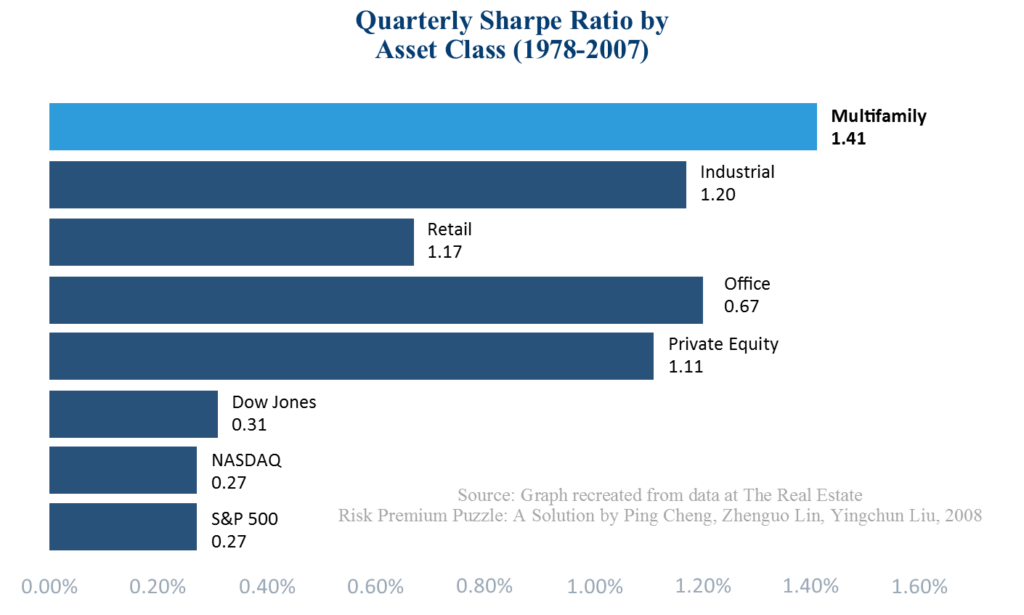

To learn more about risk and volatility, I encourage you to visit “Why Volatility Matters”
The illustrations above indicate the very tangible and powerful advantages that real estate has over any other asset class. I would never tell any investor that they need to avoid stock investing at all costs. In fact, investing in stocks has proven fruitful for many the sound investor. However, I have also seen many, including my physician colleagues, who were forced to work well into their “golden years,” because of the hit their portfolio took due to the financial crash of 2008 and 2009. Whether your approach is to avoid stocks altogether and allocate 100% of your investment into real estate, or divsersify your current investments into real estate, adding core commercial multifamily real estate to your portfolio can boost your returns while also lowering you overall risk and volatility. I personally know of no stock, bond, fund, or other traded asset that can claim all of the benefits discussed above. So, I encourage you to consider adding commercial multifamily real estate to your portfolio and “Innervate Your Investments!”

To learn more about commercial multifamily real estate investing with LRG Properties, download your free report.