
In the U.S., income is divided into three types:
1. Earned Income – income from a business or job
2. Portfolio Income – income from paper assets (e.g., interest, dividends, stock sales, etc.)
3. Passive Income – rental real estate, oil & gas, income from business in which you do not actively participate
1. Earned income...
...is the highest taxed income because it is not only taxed at ordinary income tax rates, but is also subject to the self-employment tax. As of 2017, the self-employment tax (social security and Medicare), also known as payroll taxes, is 15.3% of the first $127,200 of income. For W-2 employees, the amount withheld from their salary is only half of the tax liability, since the employer pays the other half as a deductible business expense. When you are self-employed, you pay both the employee and employer’s portion of the payroll taxes - called “self-employment taxes.” When you add the 15.3% to the 39.6% highest income tax bracket, you quickly realize why earned income is inefficient and exhausting. For me personally, this is the type of income I receive from my medical business – the highest taxed of all my income.
To illustrate, I plotted out a graph in Excel to show exactly what has happened to the self-employment tax over the past 65+ years.
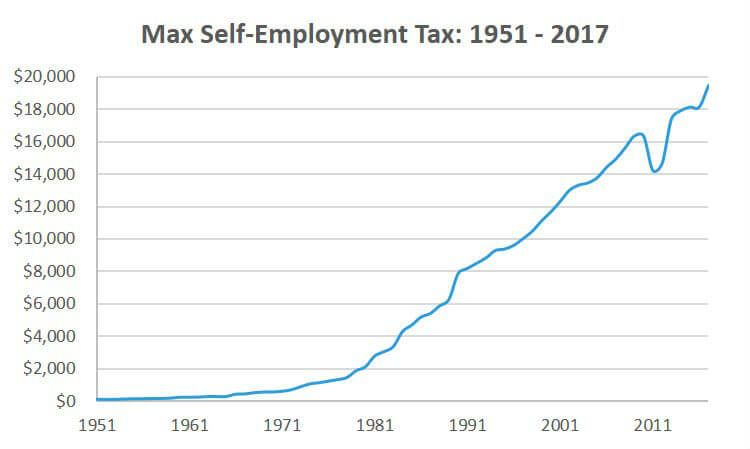
You don’t need an advanced statistics degree to see the trend! And that doesn’t include the additional 0.9% Medicare tax for those making over $200,000 ($250,000 for married filing jointly)!
2. Portfolio Income...
...is the “middle taxed” income because it is taxed at only ordinary tax rates – no self-employment tax. However, it is not easy to offset this income with expenses and other losses. For me personally, this would be the type of income I receive from my mutual fund investments – certainly more tax advantaged than earned income, but not necessarily the best.
3. Passive Income...
...is the lowest taxed of the three. Similar to portfolio income, it is taxed at only ordinary tax rates (no self-employment tax). However, it is a bit different in that passive income is easy to offset with losses from other passive investments. Passive losses can be applied toward passive gains from other activities. For me personally, I earn passive income (K1 income) from my investment in the surgery center where I operate. As a part owner of this surgery center, I have "earned income" from the procedures I perform, but also obtain "passive income" as a business owner "not materially participating in the business of the surgery center."
It just so happens that the government in all its wisdom decided to incentivize the public to invest in real estate - and made all income and losses from real estate "passive" in nature. Thus, although I see positive cash flow from my apartment investments, I am able to appreciate the paper losses from depreciation and furthermore apply those excess losses in any given year against other passive income, such as my surgery center "passive income!" This is why passive income is the best type of income to attain from a tax perspective.
Yet the benefits of passive income don’t stop with the tax advantages. It can also be a type of income that doesn’t require your time – “mailbox money.” You don’t have to trade your time for money – you can make money in your sleep. Time is nonrenewable. There is a famous saying that goes, “Rich people buy time, while everyone else sells it.”
Real estate investing can be done either actively or passively. For many, active ownership has become synonymous with “landlord!” We’re talking tenants, toilets, and 2 AM phone calls! This fear alone keeps many out of this asset class altogether – and for those that do decide to make the leap into active investing, they leave frustrated and burned out. After all, what most people want is to be investors, not landlords!
However, there is another way. Passive ownership of real estate can allow those without expertise or inclination to be a landlord, to successfully invest in real estate. They can leverage the specialized knowledge of real estate professionals and invest along side them passively. In this way, they can enjoy the benefits of direct ownership without the responsibilities of management!
As a fractional owner in a legal entity that owns real property, the passive investor receives all of the benefits of owning real estate – percentage ownership of cash flow, tax benefits, and passive income!
I encourage you to find out more on how you can leverage LRG Properties’ expertise to invest in commercial multifamily across stable markets in the U.S., creating streams of tax-advantaged passive income – and “Innervate Your Investments!”
To learn more about commercial multifamily real estate investing with LRG Properties, download your free report.